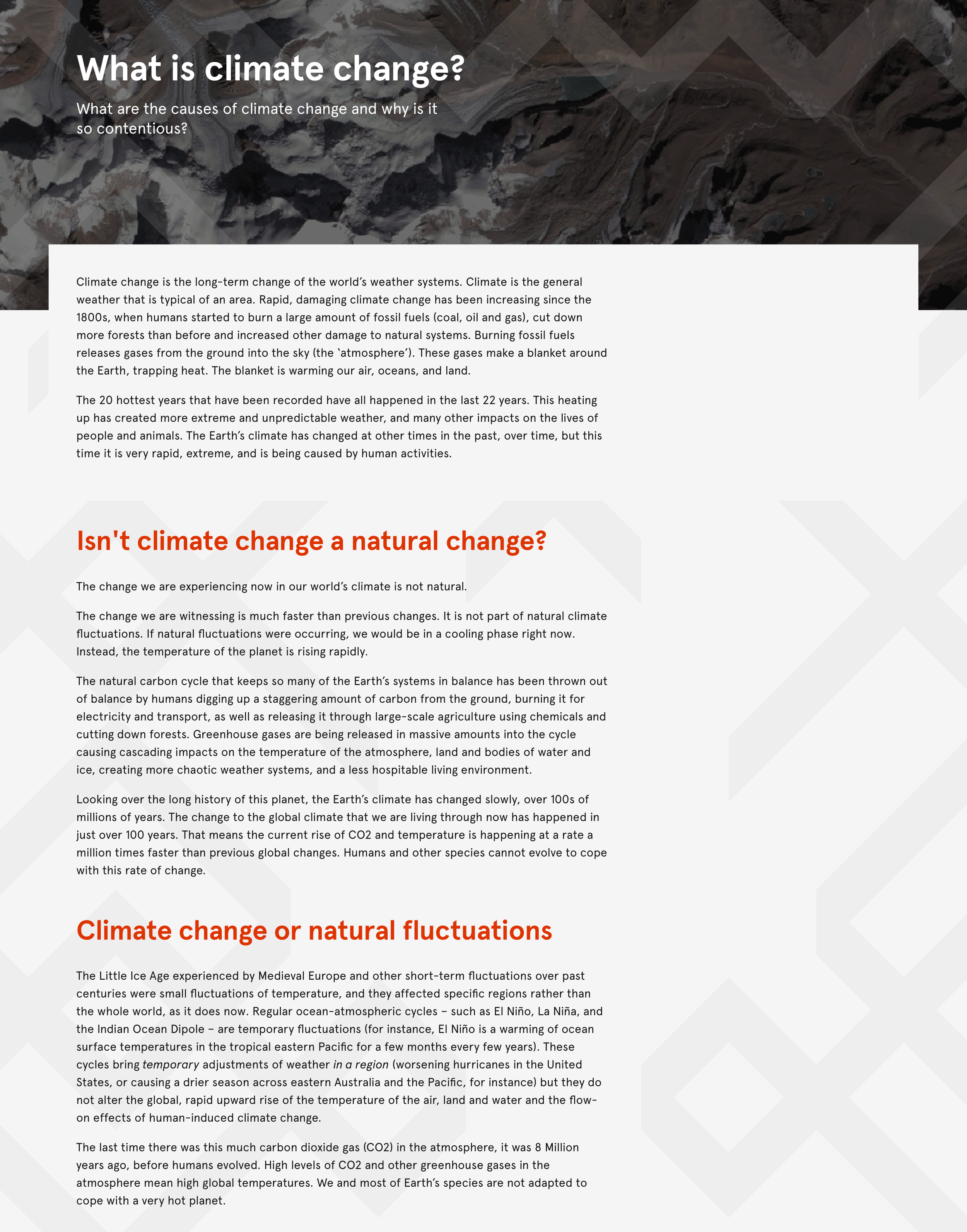
A content rewrite of the Australian Museum's 'What is Climate Change?' page. I focused on restructuring and expanding the content for a general audience, with clearer definitions, stronger narrative flow and improved scannability. I kept the scientific information concise but accurate with various sources used.
About the original
The original page covered the key facts about climate change but read as dense and academic in places. Long paragraphs assumed prior knowledge and headings were too long. The explanation of core concepts like CO2 and the greenhouse effect wasn't clear enough for a general audience.
Australian Museum — What is Climate Change?
What I did
Rewrote headings to be clearer, more concise and engaging — posing questions where they address common doubts or misconceptions people have about climate change
Rewrote in plain English throughout — accessible to a general audience without dumbing down the science
Added a dedicated section explaining CO2 and the greenhouse effect — a gap in the original
Added a section addressing El Niño and La Niña — a common point of confusion the original didn't tackle
Made the history of climate science narrative and human — highlighting key figures including Eunice Newton Foote, the first scientist to prove CO2 traps heat
Structured the page to build logically — from what climate change is, to why it's happening, to the scientific consensus, to the history.
My edit
What is climate change?
Few topics matter more right now, or are more misunderstood, than climate change.
Climate change, in a nutshell, is the long-term shift in the world’s temperatures and weather patterns.
This change has been caused by human activity, primarily through the burning of fossil fuels. This activity has caused an increase in CO2 in the atmosphere, pushing the greenhouse effect out of balance.
To understand climate change, it helps to know when and how it began.
When did it start?
The damage to our weather systems goes back further than most people realise.
Rapid, damaging climate change has been increasing since the 1800s, driven by changes in how humans live, work and produce energy.
Burning fossil fuels, for example, releases gases into the atmosphere. These gases make a blanket around the Earth, trapping heat and warming our air, oceans, and land.
The 20 hottest years ever recorded have all happened in the last 22 years.
This heating up has created more extreme and unpredictable weather, and many other impacts on the lives of people and animals.
Isn’t climate change natural?
It’s a question worth asking. The Earth’s climate has changed over millions of years.
But what we’re experiencing now is not natural and is different, in both speed, scale and cause.
Some shifts in climate patterns can be natural due to large volcanic eruptions or changes in the sun’s activity. But since the 1800s, human activity has accelerated these changes – through the burning of fossil fuels, deforestation, farming practices and other industrial processes.
These rapid shifts are not a part of natural climate fluctuations. If natural fluctuations were occurring, we would be in a cooling phase right now. Instead, the temperature of the planet is rising rapidly.
What about El Niño and La Niña?
You might be wondering about the warm and cool phases we’ve had over recent years, with heavy rains like El Niño and La Niña.
Regular ocean-atmospheric cycles – such as El Niño, La Niña, and the Indian Ocean Dipole – are temporary fluctuations.
El Niño, for example, is a recurring phenomenon that warms ocean surface temperatures in the tropical eastern Pacific for a few months every few years. These phenomena are not the same as climate change because they do not alter the rapid, global increase in air, land and water temperature.
The Little Ice Age experienced by Medieval Europe and other short-term fluctuations over past centuries were small shifts in temperature.
But unlike past fluctuations, which were slow enough for species to adapt, what’s happening now is moving at a pace that life can’t keep up with.
Why is this happening?
The answer comes down to how far humans have pushed the planet beyond its limits.
Carbon dioxide is at the centre of it.
The natural carbon cycle that keeps so many of the Earth’s systems in balance has been thrown out by humans digging up a staggering amount of carbon.
Greenhouse gases are being released in massive amounts into this natural carbon cycle. These gases cause cascading impacts on the temperature of the atmosphere, the land and bodies of water and ice, creating more chaotic weather systems and making the planet harder to live on.
What’s so bad about carbon dioxide?
Carbon dioxide is not all bad for the environment.
It’s a naturally occurring gas that we release through our breathing and is in fact necessary for creating a climate humans and other species can live in.
Along with other gases like methane, carbon dioxide contributes to the greenhouse effect, a process that traps heat within the Earth’s atmosphere. This trapping effect helps keep our planet at a balanced temperature that’s perfect for sustaining life.
The problem is that carbon is also generated by human-made activities like burning fossil fuels for transportation and power.
The change is happening fast
The real alarm is the speed at which this change is happening.
Looking over the long history of this planet, the Earth’s climate has changed slowly, over hundreds of millions of years.
The change we are living through now has happened in just over 100 years. That means the current rise of CO2 and temperature is happening at a rate a million times faster than previous global changes.
Humans and other species cannot evolve to cope with this rate of change.
So, are the scientists right?
Scientists have been studying the human impact on climate as far back as 1856.
Eunice Newton Foote conducted the first experiments proving that carbon dioxide traps heat in the atmosphere. She was the first to predict that rising CO2 would warm the earth.
On June 23, 1988, NASA climate scientist James Hansen stood before the U.S Senate and claimed, “the Greenhouse Effect is here”. 1988 was recorded as the hottest year since modern instrumental records began in the 19th century. He testified that the warming trend was not a natural variation and that he was 99% certain of a direct human cause.
Flashforward to today, and scientific literature citing multiple studies indicates a 99% consensus among climate scientists that humans are causing the increase in global warming.
Carefully reviewed and widely published studies continue to deepen our understanding of how climate change works.
Human activity: fossil fuels to blame
We know that human activity — specifically fossil fuel combustion — has caused the Earth to heat up, because the rise in CO2 tracks directly with the rise in global temperatures.
CO2 levels stayed steady for thousands of years and then began to spike with the beginning of the industrial revolution in the 1800s.
Since then, as we continue to burn fossil fuels, CO2 levels have pushed past the point the atmosphere can safely absorb.
The history of climate science
The 1800s - the first discoveries
In the early 1820s, Joseph Fourier demonstrated the concept of the atmosphere as a ‘blanket’ which traps heat. But it wasn’t until the 1850s that instrumental recordings of atmospheric temperature began.
In 1856, Eunice Foote, a scientist and campaigner for women’s rights, was the first to propose that CO2 levels in the atmosphere contribute to change in atmospheric temperature. She was the first scientist to predict that rising CO2 levels would cause global warming.
Three years later, John Tyndall, an Irish physicist and atmospheric scientist expanded our understanding of the heat-absorbing qualities of CO2 and water vapour in the atmosphere.
The 1930s - connecting CO2 to warming
In the 1930s, engineer Guy Callendar was the first to use real-world temperature records and CO2 measurements together. Based on his data, he argued that human emissions were already warming the planet. He predicted a permanently warmer climate in the coming centuries.
The 1950s - the Keeling Curve
The rise of computing power in the 1950s allowed for more analysis of the atmosphere.
Gilbert Plass, a physicist, predicted that CO2 levels would remain in the atmosphere for thousands of years and that global temperatures would increase by 1.1 degrees per century.
In 1958, a geochemist named Charles David Keeling proved that CO2 levels are rising and that fossil fuels are to blame. From a weather observation station at the top of Mauna Loa volcano in Hawaii, he used his own apparatus to take daily measurements of CO2 over 5 years. He found there was a steady yearly increase in CO2 levels in the atmosphere, and this had a direct link to a rise in the burning of fossil fuels.
The upward curve of CO2 that Keeling documented has informed climatologists following and is widely known as “The Keeling Curve”. Measurements at Mauna Loa have continued for more than 60 years. It is the longest record of CO2 concentrations in the world.
The 1960s–1980s onwards - the world wakes up
The most influential study into climate change was in 1967 by Manabe & Wetherald. This pioneering work was the first to represent the key elements of the Earth’s climate in a computer model and it showed what doubling carbon dioxide would do to global temperature.
"This was really the first physically sound climate model allowing accurate predictions of climate change." – Prof Piers Foster, Leeds University
The establishment of the IPCC
From the 1980s, the push for action grew, culminating in 1988 when the world’s governments created the Intergovernmental Panel on Climate Change (IPCC). Hundreds of experts – soon thousands – donated their time to groups, studying data and creating more accurate models to help state with certainty what was happening to our planet.
By 2001, the thousands of experts contributing to the IPCC’s reports concluded that it was much more likely than not that severe global warming was underway.